Main Content Section
Mississippi Delta Community College and Delta State University Sign MOU to Enhance Educational Pathways
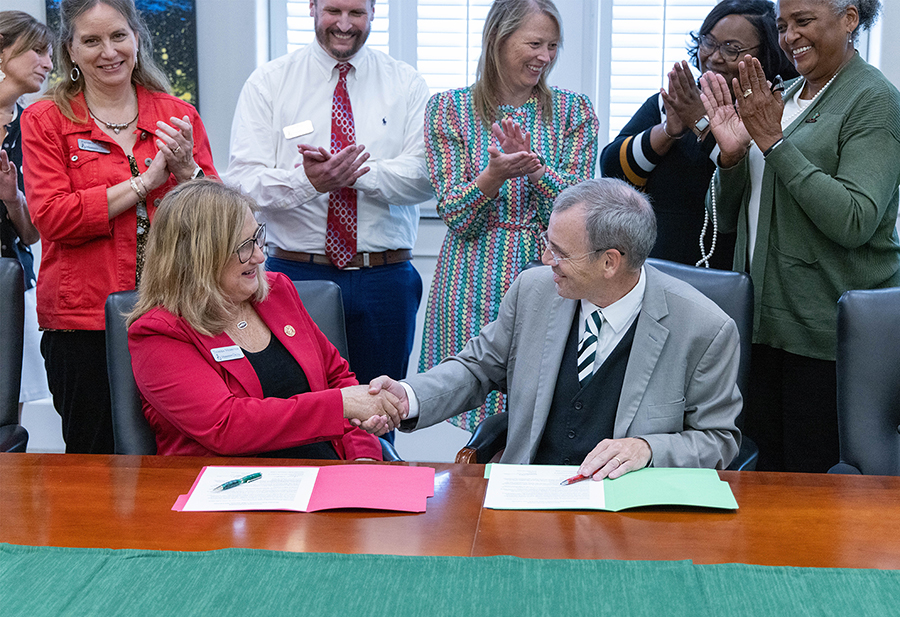
Photo by Campbell Saia
By Nathan Duff
MOORHEAD, Miss. (September 4, 2024)— Mississippi Delta Community College (MDCC) and
Delta State University (DSU) are excited to announce the signing of a new memorandum
of understanding (MOU) aimed at broadening educational opportunities and increasing
graduation rates for students at both institutions. This partnership represents a
pivotal step forward in fostering academic collaboration and providing stronger support
systems for students in the Mississippi Delta region.
Dr. Daniel J. Ennis, President of DSU, expressed his enthusiasm for this new partnership,
stating, “This MOU signifies a crucial collaboration between Delta State University
and Mississippi Delta Community College. By joining forces, we are better equipped
to offer our students the resources and support they need to succeed both academically
and professionally.”
As part of this MOU, DSU will expand its new Phi Theta Kappa Community College Residential
Award. This scholarship will be available to MDCC students who are active Phi Theta
Kappa members in good standing and have completed their Associate of Arts or Associate
of Applied Science degrees. The scholarship is designed to recognize and support high-achieving
students from MDCC as they transition to DSU.
In turn, MDCC will work closely with DSU to promote this scholarship, ensuring that
MDCC students are well-informed about the various academic programs and opportunities
available at DSU.
Teresa Webster, Interim President of Mississippi Delta Community College, said, “A
significant focus of this agreement is on increasing the number of degrees awarded
by Mississippi Delta Community College through a reverse transfer process with Delta
State. The leadership teams at DSU and MDCC will collaborate to develop shared protocols
and processes to improve data sharing and boost graduation rates for students who
attend both institutions.”
By facilitating reverse transfer, both institutions aim to enhance degree completion
at the associate and bachelor’s levels. Moreover, this partnership will explore additional
opportunities for collaboration, including co-enrollment programs, shared curricular
resources, and enhanced professional development for faculty and staff.